

By Omenihu Alfred fibmn
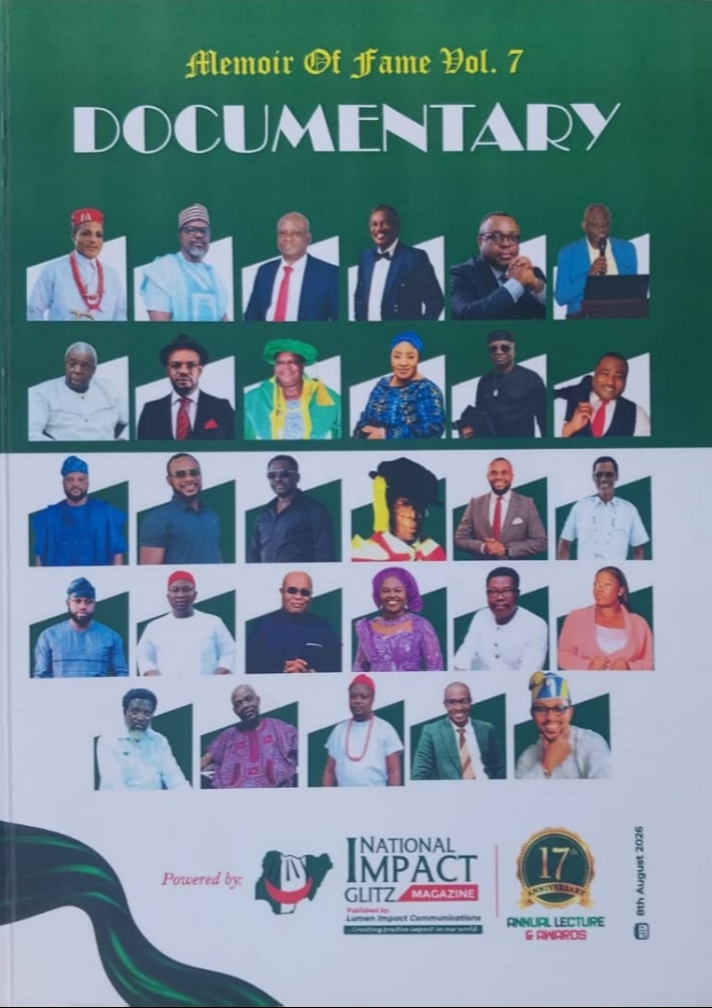
Last weekend was agog with celebration as National Impact Glitz Magazine marks her 17 years of excellence in journalism, media training, brand consultancy, annual lectures and Awards at Presken Hotel and Resorts, Ikeja, Lagos. The magazine which is being published by Lumen Impact Communications is leading a leading general interest magazine media house doing its best to create positive Impact. The epoch-making event featured lecture on the theme, Nigeria’s growth paradox; unlocking the economy’s full potential and creating agenda for Nigeria’s 2027 presidency, Keynote speeches from various sectors, Awards, and cutting of the anniversary cake.
In his welcome address, the Publisher/Editor-in-Chief, Mr Omenihu Alfred fibmn, said “today is not just another anniversary, it is a celebration of resilience, consistency and purpose. Seventeen years ago, we set out with a simple but powerful vision; to build a media platform that would tell positive stories, celebrate excellence, and hold a mirror to leadership and service in our society. By the grace of God and dint of hard work, that vision has become a movement and institution. For 17 years we have documented the journeys of nation builders, projected integrity over mediocrity, and celebrated a credible platform where hard work is seen, heard and honoured.”
“It has been 17 years of credible reporting, insightful features, and strategic media solutions with over 160 impactful editions: covering politics, business, culture, lifestyle, Market place, events coverage, Entertainment, Gospel corner and human-interest stories that shape public conversation. Over the past 17 years, the organization has trained over 40 Journalists, equipping young writers, reporters, and editors with practical skills for modern media practice, mentoring talents that now works across top media organizations and other sectors of the economy in Nigeria and beyond. The organization has also delivered Media Consultancy; providing communications, branding, and Public relation advisory to companies, public figures, and individuals seeking to amplify their voice.
In another development, the organization championed 10 years of motivation education and career counseling in the secondary schools in Imo state titled “Rule your world’. The project which led to the publications of several editions of the educative and inspirational “Grand Impact Magazine” for secondary schools featured programmes as Annual Science quiz, Arts and Commercials Quiz, The power of speech, Essay competitions, Beauty pageant and Sports. More so, the organization has ventured into lots of partnership with so many corporate entities and when Nigeria was at 60 the organization champion the first ever publicized National prayer Summit which featured over 60 men of God at National Stadium Surulere Lagos.
The 17 years of impact, achievement, milestone and prospective vision which was under the distinguished Chairmanship of Professor Dr Simon E. Okoro featured other top dignitaries as High Chief Amb Dr Nzeribe S Okegbue Ph.D – President/Chairman of Council, Employers Association for Private Employment Agencies of Nigeria (EAPEAN), Sir Stanley C. Amuchie (KSC)-Chief Operations & Information Officer Executive Director, Fidelity Bank Plc, Dr Island C. Anyasi – Chairman/CEO Sheriff Deputies Ltd, Kleenrite Ltd, Much@once Super Market and Brig General Dr Otu Oviemo Ovadje (Rtd) as Special Guests of honour. The fathers’ and mothers’ of the day include Prof JN Onyekpe – HOD, Department of History and Strategic studies University of Lagos, Prof Bright C. Nnabuihe – HOD, Department of Linguistics, African, and Asian Studies, University of Lagos, Hajia Bola Muse – CEO Bomorah Group, Mrs Badejo Henrietta Adebola C. – Registrar Yaba College of Technology while the Guest speaker remains our own Cerebral intellectual Oracle. Professor M.O Adamu of the statistics department, University of Lagos.
Looking ahead, the media house reaffirms its commitment to innovation in publishing, deeper investment in journalism training, and expanded consultancy services to help brands and individuals communicate with clarity and influence. The organization is dedicated to quality journalism, media capacity building, and strategic communication.
In his opening remark, the cerebral Chairman of the occasion stated thus; “Nigeria is, by any objective measure, a nation of extraordinary endowment. It is the largest economy in Africa by nominal GDP, the most populous nation on the continent with over 220 million people, the possessor of the largest proven oil reserves in Africa, the holder of vast deposits of solid minerals including gold, iron ore, coal, limestone, and lithium, and the home of one of the most entrepreneurially dynamic and intellectually gifted populations in the developing world. And yet: Nigeria ranks among the countries with the highest number of people living in extreme poverty globally.”
“Her infrastructure deficit is estimated at over $3 trillion. Her electricity generation capacity remains chronically insufficient, with the national grid unable to sustain even 5,000 megawatts of stable power for a population that requires at minimum 100,000 megawatts for full industrialisation. Her manufacturing sector contributes less than 10% of GDP. Her agricultural sector, which employs the majority of her workforce, operates largely at subsistence level. Her educational system produces graduates at a rate that far outpaces the economy’s capacity to absorb them productively. And her ranking on virtually every global competitiveness, ease of doing business, and human development index consistently places her in the bottom quartile of nations.”
This is the paradox. Enormous endowment. Persistent underperformance. The gap between what Nigeria is and what Nigeria could be is not a gap of resources — it is a gap of governance, institutions, and strategic intent.
Continuing, the distinquished Chairman said, “The British colonial administration designed Nigeria’s economic infrastructure — its railways, its ports, its administrative systems — not to develop Nigeria but to extract Nigeria’s resources for metropolitan benefit. This created an economy oriented outward toward export rather than inward toward domestic value creation, a pattern that has proven extraordinarily durable.”
“The discovery of petroleum in commercial quantities in 1956 and the subsequent oil boom of the 1970s did not liberate Nigeria from the extraction model — it deepened it. Oil revenues created a rentier state psychology in which government derived its income not from taxing productive economic activity but from selling a natural resource, fundamentally severing the accountability link between government and citizens. When oil prices rose, the state expanded recklessly. When they fell, the state contracted painfully. The non-oil economy was systematically neglected, crowded out, and eventually atrophied. The colonial state bequeathed institutions designed for control rather than development. The post-independence political class, rather than redesigning these institutions for developmental purposes, largely captured them for patrimonial distribution. Military rule, which dominated Nigeria’s political life for the majority of the post-independence period, further eroded institutional capacity, professionalism, and the culture of accountability. The democratic transition of 1999, while enormously significant, inherited severely weakened institutions that twenty-seven years of electoral democracy have only partially rehabilitated.”
While presenting the lecture of the day, on the theme, “Nigeria’s Growth Paradox: Unlocking the Economy’s Full Potential, Setting the Agenda for Nigeria’s 2027 Presidency. “the guest Speaker Prof M.O Adamu stated thus, “seventeen years of impact is not merely a celebration of time; it is a celebration of relevance, resilience, and responsibility. Today, I have been asked to speak on a subject that is not only timely but deeply consequential to the future of our dear nation. This topic is important because Nigeria today stands at a defining crossroads.”
“Nigeria as a nation is blessed with enormous natural resources, a youthful population, entrepreneurial energy, strategic geographic positioning, immense agricultural wealth, and one of the largest markets in Africa. Yet, paradoxically, millions of Nigerians continue to experience: poverty, unemployment, inflation, insecurity, weak infrastructure, and declining purchasing power etc. The question therefore becomes: Why is a nation so rich producing so many poor people? That is Nigeria’s growth paradox.”
The erudite scholar who has travelled far and wide talked around eight segments: Understanding Nigeria’s Growth Paradox, The Nigeria We Must Confront Honestly, The Signs of Hope in Nigeria, What Must Nigeria Do Before 2027?, Setting the Agenda for Nigeria’s 2027 Presidency, The Role of Higher Institutions, A Word to Nigerian Youth, Final Reflection: Can Nigeria Rise?
“Nigeria is often called: the “Giant of Africa,” Africa’s largest population, and one of Africa’s biggest economies. Yet many citizens do not feel the “bigness” of the economy in their daily lives. This contradiction is the heart of our paradox: Economic potential without corresponding human prosperity. Nigeria grows statistically, but not inclusively.
Our GDP may rise, yet: hunger rises, unemployment rises, inequality rises, migration rises, frustration rises.”
“According to the IMF and the World Bank: Nigeria’s economy grew around 3.4% in 2024, with projections around 3.4%–4.2% in coming years. Yet inflation remained painfully high, especially food inflation. Poverty levels have continued to increase despite reforms. Nigeria is therefore experiencing what economists call: “Growth without development.” Because true development is not measured only by GDP. True development is measured by: jobs, electricity, healthcare, education, security, transportation, food affordability, and human dignity.”
Concluding, he assured the audience that Nigeria can rise but national greatness is not automatic sating that;
“Potential alone does not build nations.
Resources alone do not create prosperity.
Population alone does not guarantee progress.
Vision, discipline, institutions, and leadership transform nations.
Singapore had no oil. South Korea emerged from war. China transformed through productivity. Rwanda rebuilt from tragedy.”
“Nigeria too can rise — if leadership becomes purposeful, if institutions become stronger, if corruption reduces, if citizens become productive, and if government becomes accountable.”
“As we approach 2027, Nigeria must choose between: politics of division or politics of development, leadership of slogans or leadership of substance, consumption or productivity, stagnation or transformation. The next presidency must not merely seek to win power. It must seek to rebuild a nation. Let us therefore commit ourselves to building: a productive Nigeria, an inclusive Nigeria, a secure Nigeria, an innovative Nigeria, and a prosperous Nigeria. May the next chapter of Nigeria be defined not by wasted potential, but by fulfilled destiny.”
In the category of National Impact Pilar Award 2026, the following top Captains of industry and academic dons; Amb. Chief Nzeribe S. Okegbue, Ph/d, Sir Stanley Chiedoziem Amuchie, Dr Adewoye S. Olabode, Dr. Island Chinazaoku Anyasi, Comrade Jeffery Ugochukwu Orji, Mr Casmir Chibuzor Azubuike, and Chief Sir Chibuzor Ernest Enwereuzor, JP were selected
For National Gold Merit and Excellent Performance Award 2026, the following, Prof Dr Amb. S.E Okoro, Dr Azeez Abayomi Mustapha RFFI, FIMS, Mr. Amos Rapuluchukwu Anago, MOD Col E.O Nwokeabia, Pharm Nwachukwu Edith Uchenna, Chief Sylvanus Duru Ike, Hon. Dr. Musa Oluwasegun M. Musa made the list. The category of National Youth Ambassador Award 2026, had icons as Engr Martins C. Onyebuenyi, Chief Ambassador Obi Christian, and Comrade Omenihu Peter Chiemele while Hon Dr Bayo Adefuye bagged National Gold Merit and Leadership Excellence Award.
The Centenary Wellness Award went to Mazi Uriah Iheanyichukwu Ogu (The Chosen) while Prof Uzochukwu Sam bagged the academic legend Award as the maritime Journalist of the year went to Comrade Dili Nicholas Utomi
Furthermore, the event featured Hajia Idayat Bola Muse and Mrs. Herietta Adebola Gbemisola Badejo as Mothers of the Day and National Impact Amazon Awardee. The event equally paid tributes to Prof. J.G. N Onyekpe and Prof Bright Chigozie Nnabuihe as fathers of the day. Finally, National Impact Legacy Award went to MARK Columbus Orgu and Victor Cletus for living the positive legacy of National Impact Glitz Magazine.

