

By Chris Njoku
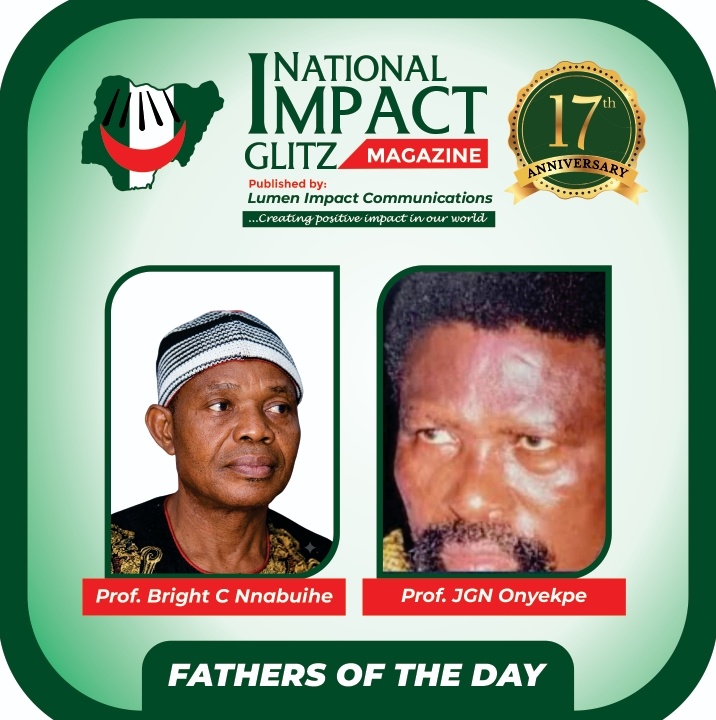
National Impact Glitz Magazine published by Lumen Impact Communications wish to announce and celebrate the worthy fathers of the Day for the forthcoming 17th Anniversary, Lecture and Awards of National Impact Glitz Magazine as Prof. Justin Godwin Nkemchonobi (J.G.N.) Onyekpe and Prof. Bright Chigozie Nnabuihe. The epoch-making event which will be held at Presken Hotel and Resorts, Ikeja, Lagos will feature lecture on the theme, Nigeria’s growth paradox; unlocking the economy’s full potential and creating agenda for Nigeria’s 2027 presidency,
Prof. Justin Godwin Nkemchonobi (J.G.N.) Onyekpe is an eminent Nigerian historian, author, and academic leader. He serves as the Head of the Department (HOD) of History and Strategic Studies at the University of Lagos (UNILAG). He provides core administrative and academic steering for the Department of History and Strategic Studies within the Faculty of Arts at the University of Lagos.
Prof. Onyekpe built his entire academic lecturing career at UNILAG, initially joining the institution as a Graduate Assistant in 1986 and climbing up through the positions of Assistant Lecturer, Senior Lecturer, and Reader to full Professor. He is widely acknowledged within West African academic circles as a Marxist scholar and proletarian internationalist. His primary research focuses on political economy, grassroots governance, and agrarian development. His notable works explore the deeper drivers of underdevelopment, including pieces like Understanding Nigeria’s Political Economy and Culture of Underdevelopment and Anatomy of Nigeria’s Economic Crisis.
He authored the prominent UNILAG Faculty of Arts monograph, Ownership and Use of Land in Twentieth-Century Nigeria: A Survey and Critique, alongside structural critiques regarding grassroots development. He is an active advocate for youth mentorship, pushing for structural guidance to redirect youth energies away from restiveness toward socio-political awareness and the rule of law.
Prof. Onyekpe regularly features as an expert authority across major media platforms—including investigative features with the BBC—where he analyzes archaeological and linguistic lineages to trace West African migration patterns and ethnic identities. In 2010, he was inducted into the Historical Society of Nigeria (HSN) as a fellow during its 54th Annual Congress in recognition of his extensive commitments to propagating historical knowledge.
Going forward, Prof. Bright Chigozie Nnabuihe is an eminent Nigerian scholar, academic leader, and a Professor of Igbo Language, Culture, and Linguistics. He serves as the Head of the Department (HOD) of Linguistics, African & Asian Studies at the University of Lagos (UNILAG).
He oversees the academic and administrative leadership of the Department of Linguistics, African & Asian Studies within the Faculty of Arts at the University of Lagos.
His academic scholarship centers extensively on African linguistics, sociolinguistics, Igbo literature, and the documentation of native dialects. He has written and co-authored several key publications and academic academic resources, including the well-known text Udezuluigbo: a festschrift in honour of Sam Uzochukwu and investigative papers evaluating indigenous language publications in Nigeria.
Nnabuihe is widely recognized across Nigeria as an outspoken champion for the revitalization of local mother tongues. As a keynote speaker for high-profile cultural gatherings, he has famously and strongly refuted the UNESCO prediction that the Igbo language is sliding into extinction, arguing that its massive baseline of global speakers secures its status as a major language.
In a major bid to combat language decline among youths, he authored the 135-page educational book Kà Ànyi Mu Asusu Igbọ (Let us Learn Igbo Language), commissioned by Ọgbakọ Asụsụ Igbọ Lagos to offer bilingual basic learning for children. He frequently features on media platforms (such as the BBC) as an expert authority to break down the history of traditional customs, core Igbo values, and the historical evolution of specific local etymologies.

